
If you’re moving to Dubai, or simply re-evaluating your budget, you’re likely asking the same question: “How much do I actually need to live comfortably?”
The short answer: for most people, comfortable living in Dubai starts around AED 12,000-16,000 per month for singles, AED 18,000-25,000 for couples, and AED 25,000-35,000+ for families, depending on lifestyle and schooling choices. Costs are rising, yes, but they remain manageable with clear expectations and disciplined planning.
Dubai can be expensive, but with the right approach, and the right tools, you can not only live well but also save consistently. In this guide, we’ll break down the true cost of living in Dubai, the income levels that align with a “comfortable” lifestyle, and the strategies you can use to manage your money more effectively.
Understanding what “comfortable living” actually means in Dubai
“Comfort” is relative, but in Dubai, it usually means renting in a good neighbourhood, managing predictable monthly costs without strain, and still having room for savings, social life, and occasional travel.
The gap between “surviving” and “comfortable” is not defined by luxury. It’s defined by predictability, knowing your non-negotiable expenses, selecting the right neighbourhood, and avoiding lifestyle creep.
Recent 2025 estimates show the typical cost of living in Dubai:
- Single person: AED 6,000-17,000/month depending on location and lifestyle
- Couple: AED 10,000-23,000/month
- Family of four: AED 17,000-37,500+/month
Why the enormous range? Neighbourhoods vary dramatically. Imported goods are expensive. School fees can double your monthly outgoings. But Dubai’s biggest financial advantage remains unchanged: no income tax. Your gross income is your net income, giving you more room to manoeuvre than in most global cities.
Breaking down the major cost categories
If you understand the five major cost-drivers, housing, utilities, groceries, transport, and schooling/healthcare, you understand the real cost of living in Dubai.
As a rule of thumb, housing dominates every budget, often representing 35-50% of monthly spending. Everything else builds around it.
Housing and rent
Your rent will determine everything else: neighbourhood, commute, lifestyle, even social circles. The variation is wide:
- 1-bed apartment in mid-market areas (JVC, JLT, Al Barsha): ~AED 6,500-9,000/month
- Prime areas (Downtown, Dubai Marina, Palm Jumeirah): significantly higher, often 12-20k+
Beware of Hidden costs: agency fees, deposits, Ejari registration, potential chiller (AC) charges, and high summer utility spikes.
The truth is simple: if you get the housing decision wrong, the rest of your budget becomes a balancing act.
Utilities & internet
Electricity, water and cooling are heavily seasonal. Ask anyone who has received a summer DEWA bill-they’re never surprised, just resigned.
- Typical utilities for a 1-2 BR apartment: ~AED 578-1,200/month
- High-speed internet: ~AED 220-450/month
Peak summer cooling can double your usual costs. Apartments with district cooling (e.g., Marina, Downtown) often charge a fixed fee, so factor that in.
Food & groceries
Groceries are manageable if you shop smart and avoid imported luxuries. A typical monthly supermarket bill for individuals is ~AED 1,200-1,800, depending on preference and frequency of eating out.
Example prices:
- Milk: ~AED 7.2/litre
- Eggs: ~AED 12/dozen
- Mid-range dining out: AED 50-120 per person
- Premium restaurants: anything north of AED 250+ per person
Transportation
Dubai gives you three main choices: public transport, car ownership, or ride-sharing.
- Public transport monthly pass: ~AED 200-380
- Car ownership: cheaper fuel than many countries, but add parking, Salik tolls, insurance, servicing
- Ride-sharing: incredibly convenient, deceptively expensive if used daily
Healthcare & insurance
While most employers in Dubai provide basic health insurance, the reality is that co-pays can vary dramatically, and the moment you step outside your insurer’s approved network, the costs can escalate quickly. A standard GP visit typically runs AED 150-400, and specialist appointments often exceed that, especially if your plan only partially covers them.
Where people get caught off-guard is in the “grey area” of healthcare costs: a treatment that requires a higher co-pay than expected, a prescription that isn’t fully covered, or an urgent visit to a clinic that turns out to be out of network. These scenarios can turn a simple appointment into a surprisingly expensive bill.
If comfort is your goal, you’ll want insurance that protects you from these financial shocks, rather than coverage that technically meets the legal requirement but leaves you exposed when you actually need care.
Education (for families)
If you’re moving to Dubai with children, school fees deserve their own category. International curricula bring international pricing.
- Average international school fees: AED 54,000-145,000+ per year
For many families, schooling becomes the single largest annual expense.
Lifestyle, entertainment & misc.
Dubai has a way of nudging you toward optional expenses: gyms, brunches, weekend getaways, malls designed like theme parks. Comfortable budgets typically account for:
- Gym memberships
- Occasional dining out
- Cinemas, leisure activities
- Mobile plans
- Subscriptions
The goal isn’t to strip lifestyle, it’s to predict lifestyle.
How much income you realistically need
Here are practical monthly income ranges we see most often for a comfortable, balanced lifestyle in Dubai.
These are not survival budgets, they allow room for saving, enjoyment and the occasional upgrade.
For single professionals
Comfortable range: AED 12,000-16,000/month
This typically covers rent in a mid-market area, utilities, groceries, transport and modest entertainment.
Mid-level professional salaries in Dubai commonly fall between 15,000-22,000 AED/month, which aligns with this range.
For couples (no children)
Comfortable range: AED 18,000-25,000/month
Shared housing costs lighten the load significantly, leaving room for dining out, short trips and savings.
For a family of four
Comfortable range: AED 25,000-35,000+/month
The real swing factor is schooling; rent and utilities scale up as well. Families who choose high-end international schools can easily exceed this range.
How to manage and control your cost of living
You can make Dubai dramatically more affordable by controlling the big levers, housing, utilities, groceries, transport, and using tools that give you visibility and discipline.
Living just outside prime zones, JVC, JLT, Al Barsha, Motor City, can save 20-40% on rent with little lifestyle compromise.
Many landlords are open to negotiation, especially if you pay fewer cheques or time your renewal with slow market periods.
Small changes, efficient AC settings, closing blinds, switching to LED lighting, add up quickly.
Local supermarkets offer better value. Imported brands add unnecessary premiums.
Public transport is highly cost-effective if it suits your commute. Ride-sharing should be purposeful, not habitual.
Curriculum, location and reputation all influence cost; but higher fees don’t automatically equal better fit. Prioritise academic alignment, not prestige.
Aim to save a percentage of income every month; however small at first. The point is discipline, not perfection.
Where Clarvia helps you take control
This is where Clarvia quietly becomes indispensable.
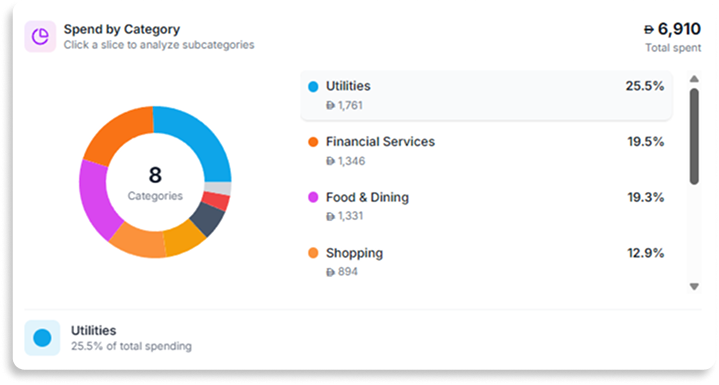
The biggest budgeting problems are rooted in uncertainty: people don’t know where their money is going. Clarvia fixes this immediately:
- Upload bank statements → everything is categorised instantly
- See overspending patterns in groceries, transport, or subscriptions
- Create intelligent budgets that adjust to your lifestyle
- Get predictive alerts (e.g., “utilities will spike next month”)
- Set clear goals-from school fee planning to saving 50k for a down payment
- Receive AI-powered savings recommendations, grounded in your real habits
Watch-outs that quietly push your cost of living up
A few overlooked factors can inflate your monthly budget faster than you expect.
- Choosing prime locations unnecessarily
- Taking on larger apartments than needed
- Relying on ride-sharing instead of planned transport
- Luxury gyms and premium grocery brands
- High school fees for international curriculum
- Summer utilities (significantly higher than winter)
- Inadequate health insurance
- Frequent travel or impulsive spending
Comfortable living doesn’t mean saying no to these, it means planning for them.
You can live comfortably, with structure
Dubai demands a thoughtful budget, but it rewards clarity.
Once you understand your cost drivers, and make conscious choices about housing, lifestyle and schooling, Dubai stops feeling expensive and starts feeling manageable.
If you want to take full control of your financial life here, upload your latest bank statements into Clarvia. You’ll get a clear view of your spending, personalised budgets, and smart forecasts that help you plan, not guess.
Start your free trial today and see how much you could save each month.